

In this lesson we offer some ideas for how to start a partnership programme at your institution.
Activity One: Partnership Planning
Show or hide video transcript
So when I started thinking about how to set up a student-staff partnership programme, I’ll be honest, I didn’t know where to begin, but I built a plan and it wasn’t a perfect one, but it was something that I could start with and then grow over time. So first I had to think about where the programme was going to live. For us, it made sense to host it in our Education office because it meant that we could reach both our academic and our professional support staff. Then I asked, who’s gonna lead this? I took it on myself because it nicely sat with my interests around inclusive higher education. But I quickly realised the value of building a team of those interested in partnership working.
So I mapped out all the key stakeholders, course leaders, support staff, students, and thought really carefully about how to engage those stakeholders. We sat down together, we defined the aims to enhance learning, foster inclusion, and give students that real world experience, and that really helped us think about the strategic importance of what we were doing. We decided to run the programme over a whole academic year because that gave us long enough to build those relationships, but also a bit of flexibility to adapt over time. Promotion was definitely a learning curve. We tried lots of strategies, newsletters, staff briefings, student networks, and so on to spread the word. Again, it wasn’t perfect, it took time, but eventually we started to build that interest in the programme.
Project proposals were invited from staff and we asked that those proposals outlined the project, the aims and objectives, the role that the student partner would take in that project, the anticipated number of hours, and also a kind of expected timeline. Funding was a bit tight. We did manage to secure an internal budget and we used that to pay our student partners for their time. And making those positions paid was really important to us because we wanted to make the roles attractive to the most kind of economically disadvantaged students in our community. Those that need to work to fund their studies.
We built in evaluation from the start, we tracked progress, gathered lots of feedback, and this really has helped us to learn and improve over time, and we celebrated successes. Even those small wins, we made sure that our students really felt valued and heard as we went through the programme. And students themselves actually helped us to shape how we work. So they suggested improvements and some have even proposed their own projects, which has been really beautiful to see. So looking back, I think we didn’t have all the answers at the beginning, but we did have a vision around what our partnership programme was and what it could do. So if you are thinking about starting a partnership programme, I’d say definitely do it. It isn’t about perfection, it’s about that collaboration and learning as you go through. In the activity below, there’s 12 key points for you to consider.
Developing a partnership plan is the first step to getting your programme off the ground. Below is a list of twelve key questions to consider and a download with the same questions where you can make your own notes
- Which department or service will host the partnership programme and why?
- Which member/s of staff will lead and coordinate the partnership activities?
- Who are your key stakeholders and what are their needs? How will you engage them in the programme?
- What does your programme set out to achieve? What will your partnership activities focus on?
- How long will the Partnership Programme run for and why?
- Where will the partnership project, opportunities be advertised to staff and students?
- How will staff and students initiate partnership projects, and what criteria will be used to select these?
- Is there funding available to support partnership projects? If so, how will this be allocated?
- How will you measure the progress and impact of partnership projects?
- How will you recognise successful partnerships and share good partnership practice?
- How will you ensure that you are working in partnership with students to design and develop the partnership programme?
- How will you recruit students into the Student Partner role?
Activity Two: Recruiting Student Partners
Show or hide video transcript
So in the second activity, we look at how to go about recruiting a student partner team. At Southampton Solent University, we’ve learned a lot about what it takes to recruit student partners effectively and meaningfully. Here’s some of the things we’ve learned along the way. First of all, we treat our student partners as paid positions, and we use our internal campus job platform to advertise these positions each academic year. So it’s a formal process because we want our students to feel valued and their contributions acknowledged. So we go into teaching sessions to talk to students directly about the opportunity, and we also make that face-to-face connection in other spaces at the university to spark interest in the roles. We don’t just limit applications to one subject area. What matters most is that student perspective, not the discipline of their degree programme. But that said, we really put a lot of emphasis on recruiting students at level five or above because we recognise that it requires some experience of being a student to be an effective student partner.
We also make a point of encouraging applications from our most underrepresented groups, so particularly students from Black, Asian, minority, and ethnic backgrounds. We really want our student partnership programme to reflect the diversity of our student body, and that really starts with that inclusive recruitment. So students apply with a CV and a covering letter, and we shortlist based on our personal specification. Shortlisted candidates come for a 15-minute interview with us where we go through a set of structured questions. And even when students are unsuccessful in their applications, we make sure that we give them really good constructive feedback. I think the biggest lesson that we’ve learned in the recruitment process is that students don’t need previous experience. What really matters is their passion for partnership. And if that passion’s there from day one, then we can create the opportunities within the programme for them to develop themselves and grow.
Think about your student partner recruitment process using the guiding questions and example answers below.
1. How will you recruit students into the Student Partner role?
At Southampton Solent University, we use our internal campus jobs application process to recruit students into paid Student Partner roles at the beginning of each academic year.
2. How will you advertise the Student Partner positions?
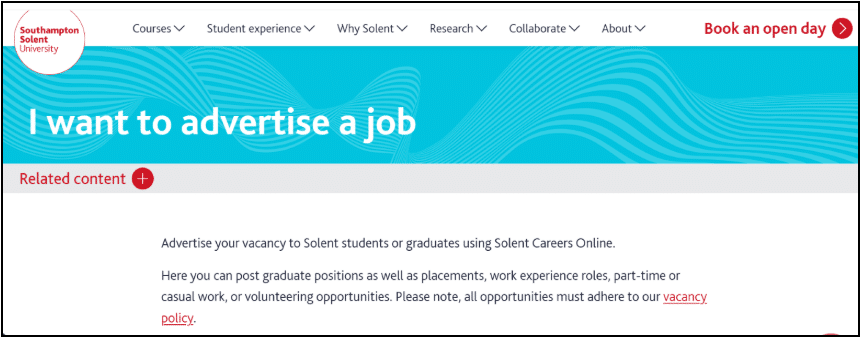
At Southampton Solent University, we advertise Student Partner positions via our Solent Careers Online webpage (see below for an example of the advert we use). We also go into teaching sessions to talk to students about the Student Partner opportunities.
Advert for Student Partner (15 positions available)
Are you passionate about staff and students working in partnership to ensure an excellent student experience? This is an exciting opportunity for you to share your views and use your experiences to have a great impact on your university!
As a Student Partner, you will work alongside members of staff as partners to help shape our educational policies and practices. You will be assigned different projects to work on throughout the academic year. Hours will vary according to the specifics of the project, but you can work flexibly around your study, and other commitments, to meet set objectives by the deadline.
No previous experience is necessary. You will receive full training for the role, and your professional development will be supported throughout the programme.
Southampton Solent University is actively committed to the principles of equality and inclusion and is working hard to increase the diversity of its workforce. We welcome applications from all sections of the student community, particularly Black, Asian, and Minority Ethnic (BAME) candidates, and disabled people. Please submit your CV and a covering letter explaining why you are interested in the Student Partner role.
3. Will you target particular students for the Student Partner positions?
For the Solent Student Partner Programme, we do not mind which discipline students are studying (their student perspective matters more to us than the subject of their degree). We like to recruit students in level 5 or above (level 4 students are new to the university and not familiar with the student experience). We especially encourage applications from students from Black, Asian, and Minority Ethnic backgrounds, and other underrepresented groups. These preferences are set out in the job advert.
4. How will you select students for the positions?
Applicants for the Solent Student Partner position submit a covering letter and curriculum vitae detailing their interests and suitability for the role. Applications are then shortlisted based on the person specification. Shortlisted candidates are invited to a 15-minute interview where they are asked to respond to a set of questions (see example below).
- Tell us a bit about yourself and why you are interested in this role
- What relevant skills (and experience) do you have?
- Why do you think student/staff partnerships are important in higher education?
- Which aspects of this role do you think you would find most enjoyable/challenging?
- As a Student Partner, you will work on different projects at once, which you will be expected to manage around your studies and other commitments. Can you give an example of a time when you had to manage multiple activities at the same time to meet a deadline?
- Finally, if you could change one thing at Southampton Solent University to make the student experience even better, what would it be (and why)?
Unsuccessful candidates are given constructive feedback on their interview and are signposted to the University Careers service for further employability support. Successful candidates are also provided with feedback on their interview and given a 12-month contract for the Student Partner role. They are then invited to join the induction and training process.
Activity Three: Partnership Induction and Training
Show or hide video transcript
So when you’re setting up a student partner programme, one of the most important things to get right is the induction and training process. It’s not just about ticking boxes. It’s about building that confidence and capability and sense of belonging to the programme. At Southampton Solent University, we’ve developed a structured and supportive approach that’s evolved over time. First, we start with our essentials training, and this includes GDPR, Prevent, equality and diversity, and Health & Safety training. It’s delivered asynchronously online by our people and development team. Then we move into our Solent student partner induction, and this is synchronous in-person sessions led by myself as the programme lead, and also our student partner alumni.
We cover everything from partnership values, we share past project stories, challenges, opportunities, and we also do a skills audit. We also talk about how students get paid, what the projects will involve, and also how they will have opportunity to grow professionally. Training doesn’t just stop after that induction. Student partners receive project-specific skills development on a needs basis, whether it’s software, data analysis, or something else. And this is delivered by our individual project leads, either in person or online. And we bring all of our student partners together for monthly team meetings, and these sessions are a really important space for reflection, peer support, and troubleshooting. And as students grow in confidence, they start to lead part of those training sessions themselves.
So all of our training is mandatory and paid because we believe it’s really important that partnership is a professional commitment, and students really deserve to be recognised for the time and effort that they put into the programme. And what we found is really when students feel prepared, supported, and valued, they really thrive in the partnership roles. In the text below, there’s a structure for you to consider in terms of inducting and training student partners.
Design an induction and training process for your Student Partners which builds their confidence and capabilities in partnership working. Consider the following questions:
- What will you cover?
- Will the training be mandatory or non-mandatory?
- Will the training be paid/unpaid?
- Who will deliver the training?
- How will the training be facilitated (synchronously/asynchronously)?
- When will you deliver this training?
Below is an example of how we train our Student Partners at Southampton Solent University, all training is mandatory and paid:
| What | Who | How | |
| Essentials University training (October) | General Data Protection Regulation Prevent Strategy Equality and Diversity Health and Safety | People and Development Team | Asynchronous online |
| Solent Student Partner Induction (October) | Introduction to the programme and each other Partnership working and values Stories of previous Student Partners Examples of past projects Challenges and opportunities Reflection and skills audit Planned partnership activities Participating in projects and getting paid Ongoing professional development | Programme Lead and Student Partner alumni | Synchronous in person |
| Project-based skills training (Ongoing) | Student Partners are trained in specific project skills on a needs basis. For example, this could be in particular software programmes or data analysis techniques that will be used | Individual Project Leads | Synchronous in-person or online |
| Continued support and development (Ongoing) | Student Partners are brought together in monthly team meetings to discuss experiences of partnership working. This helps build collegiality in the team and collectively troubleshoot challenges. It also provides an opportunity for ongoing training and development where required. As Student Partners become more confident in the role, they begin to take the lead in initiating and facilitating this training themselves. | Programme Lead and Student Partners | Synchronous in-person or online |
At Southampton Solent University, we recognise that Student Partners need to be empowered through ongoing training and development. Partnerships can be emotional, so we create lots of space for collective discussion and peer support within our team. Here’s an example of how we use creative methods of reflection to support students to navigate the challenges of partnership: Partnership at play: empowering Student Partners to navigate third space.
Students develop a wide range of employability skills and experiences as a Student Partner, but they don’t always see the relevance of these to their wider career aspirations. Here’s an example of an initiative we used to help our Student Partners articulate the broader skills and experiences they were gaining through partnership work: The Living CV.
Discussions
Where do you think you might start with implementing a partnership programme for your institution?
Please share your thoughts and questions in the comments section below.