
Show or hide video transcript
So when we talk about student-staff partnerships in higher education, we’re talking about more than just working together. We’re talking about a collaborative, reciprocal process where everyone is contributing equally, although not necessarily in the same ways. Partnerships really challenge the idea that students are just consumers of education. Instead, they recognise learners as active agents with lived experiences and ideas about how they can improve learning and teaching. Staff bring their expertise in teaching, students bring their expertise in being students. And when we bring those things together, that’s when the magic happens.
So partnerships go beyond student voice initiatives. They’re not just about collecting feedback from learners and acting upon it. They’re about that genuine collaboration where staff and students are exchanging ideas and making meaningful change together. The Sparqs model referenced in the text below shows this beautifully. Students climb a staircase from being information providers, to actors, to experts, and finally to partners. And the higher up the staircase they go, the more impactful the change becomes because it’s based on deeper, more contextualised understanding of what needs to change and how that should happen. Partnerships help us reflect critically, challenge assumptions, and explore new ways of working to include those diverse perspectives in our learners. And there’s not one size fits all.
Catherine Bovill’s topology reminds us that partnerships can take many, many different forms, depending on who initiates them, what the focus is and how students get involved. Whether it’s a one day workshop or perhaps even a whole long year programme, partnership practise can be adapted to fit the context and the people involved. And there’s a whole rich research base around this topic. Journals like “The International Journal for Students as Partners”, and “Education, Innovation and Change”, and “Teaching and Learning Together” are really full of inspiring examples of partnerships in practise. They show a whole host of benefits for staff and students. And it’s not just about staff and students, institutions benefit too. Research shows that partnerships improve student attainment, retention and graduate outcomes. And in fact, in the UK, partnerships are now embedded in our higher education policy. They’re part of our UK Quality Code, our Office for Students’ Teaching Excellence Framework, and they’re an integral part of the Advanced HE, Professional Standards for Teachers and Supporters of Learning.
Student-staff partnership is “a collaborative, reciprocal process through which all partners have the opportunity to contribute equally, although not necessarily in the same ways, to curricular or pedagogical conceptualisation, decision making, implementation, investigation or analysis” (Cook-Sather et al., 2014, pp. 6–7). Partnerships oppose transactional models of higher education in their recognition that students are not consumers of higher education, but active agents within it. Whilst staff have expertise in teaching, students have expertise in what it is like to be a student and ideas for how their experiences can be improved. As Healey argues, “Partnership working is a catalyst for social justice, inclusivity, and transformation, by recognising the right of students to actively drive their educational experience” (Healey,2023, p.3).
Partnerships move beyond student voice initiatives (where students provide feedback and staff action it) to genuine and authentic collaboration (where students and staff exchange ideas and make meaningful change together). This is represented in the SPARQs student partnership model illustrated below.
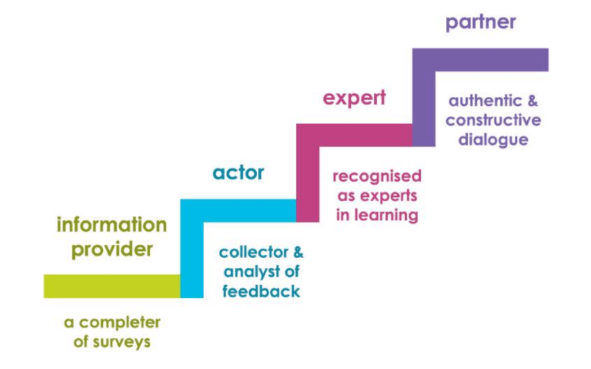
Evidence suggests that changes made through the higher steps of the staircase (expert and partner) are more impactful than the lower steps (information provider and actor) because they are based on a clearer and contextualised understanding of where, how, and by whom enhancements can be made. As Healey argues, “By working in partnership, students and staff can dismantle traditional hierarchical relationships and learn from one another to identify implicit assumptions, critically reflect on experiences, and explore new ways of learning and working in higher education that consider diverse perspectives” (Healey, 2023, p.4).
An extensive research base has demonstrated that partnership working can happen in a myriad of ways. Yet as Bovill (2019) points out, the literature can be confusing due to the different terminology used when discussing partnership working. Terms such as students as ‘Partners,’ ‘co-creators,’ ‘co-inquirers,’ ‘consultants’ and ‘change agents’ are used interchangeably across partnership projects. To make sense of this variability of practice, Bovill developed a tool to help categorise partnership practices (see adapted version below):
| Question | Possible responses | |||||
| Who initiates the partnership? | Staff-led | Student-led | Staff and students | |||
| What is the focus of the partnership? | Entire curriculum | Learning and teaching | Educational research | Disciplinary research | Wider student experience | |
| What is the context of the partnership? | Curricular | Extra-curricular | University wide | |||
| How many students are involved? | 1-5 | 6-10 | 11-20 | 21-30 | 31-100 | 101+ |
| Have you selected students, or does it involve the whole class/ group? | Selected | Whole class/group | ||||
| Which students are involved? | Retrospective | Current | Future | |||
| What level of study are the students in? | Level 4 | Level 5 | Level 6 | Level 7 | Level 8 | |
| What is the timescale of the project? | Days | Months | Years | |||
| What is the role of the student? | Representative | Consultant | Co-researcher | Pedagogical co-designer | ||
| What is the nature of student involvement? | Informed | Consulted | Involved | Partner | Leading | |
| What is the reward/recompense given to students? | Payment in money | Payment in vouchers | Course credit | No payment | Refreshments | |
| What is the purpose of the partnership? | To improve the course | To enhance student engagement | Aiming for socially just higher education | Impressed by the benefits | Want student perspectives | To enhance student skills |
Bovill’s typology is a useful reminder that there is no single way of doing partnership – practice can and should be adapted according to the needs and context of each project. There is no shortage of examples of partnership projects in the literature (Mercer-Mapstone et al. 2017). Many academic journals publish papers on student-staff partnership projects, and some are dedicated to discussing the research and practice of partnership working. For example:
- International Journal of Students as Partners
- Journal of Educational Innovation Partnership and Change
- The Student Engagement in Higher Education Journal
- Teaching and Learning Together in Higher Education
The benefits of student-staff partnerships are well documented in the academic literature. Studies show that working together brings an array of benefits for both educators and students, such as:
- Strengthens learning community
- Enhances the student experience
- Increases student engagement
- Supports educational improvements
- Drives cultural change towards partnership
- Supports students’ learning
- Increases sense of belonging
- Empowers learners
- Enhances study motivation
- Builds confidence and agency
- Develops transferable employability skills
Across the higher education sector, there is increasing recognition of the benefits that partnership working also brings to institutions. Research shows that partnerships have a positive impact on student attainment, retention, and graduate outcomes (Peart et al. 2023). This has put partnership at the forefront of higher education policy and regulator developments. For example, in the United Kingdom, institutions are required to meet expectations for working in partnership with students as part of the UK Quality Code for Higher Education (QAA, 2025). They are also required to demonstrate how they engage students as partners in the enhancement of their provision as part of the Teaching Excellence and Student Outcomes Framework. Partnership working is also at the heart of the globally recognised Advance HE professional standards for teachers and supporters of learning (AdvanceHE, 2024). It is therefore not surprising that institutional partnerships programmes have become more common in higher education over the past few years.
In the next lesson, we will provide details of our university-wide programme of student-staff partnership before sharing some ideas for how you could start one in your own institution.
- AdvanceHE (2024) Essential Frameworks for Enhancing Student Success: Student Engagement through Partnership, AdvanceHE.
- Bovill, C. (2019) A co-creation of learning and teaching typology: What kind of co-creation are you planning or doing? International Journal for Students as Partners, 3(2), 91-98.
- Cook-Sather, A., Bovill, C., and Felten, P. (2014) Engaging Students as Partners in Learning and Teaching in Higher Education: A Guide for Faculty. Jossey-Bass.
- Healey, R. (2023) A guide to working with students as partners, Centre for Academic Innovation and Development, University of Chester.
- Mercer-Mapstone, L., Dvorakova, S. L., Matthews, K. E., Abbot, S., Cheng, B., Felten, P. and Swaim, K. (2017) A Systematic Literature Review of Students as Partners in Higher Education. International Journal for Students as Partners, 1(1), 15–37.
- Peart, D., Rumbold, P. and Fukar, E. (2023) Student Engagement Through Partnership: A Literature Review, Northumbria University.
- QAA (2025) UK Quality Code for Higher Education: Advice and Guidance – Sector Agreed Principle 2 – Engaging Students As Partners, Quality Assurance Agency.
- Varwell, S. (2021). Models for exploring partnership: Introducing sparqs’ student partnership staircase as a reflective tool for staff and students. International Journal for Students as Partners, 5(1), 107-123
Discussions
Use Bovill’s (2019) typology to reflect on the different ways that partnerships can happen in higher education. How could your course/service/department/faculty/university embrace opportunities for working in partnership with students?
Please share your thoughts and questions in the comments section below.