
Click here to view the video transcript
Let’s talk about some specific applications of the ACCCE model, and we’re going to go in order. A, the three C’s and E. So first, if we look at Academic culture, that has to do with your planning and your announcements. It also has to do with the introduction of students, how you’re bringing them into the course and what that looks like.
So for instance, a lot of instructors say something like this. If you’re talking about an introduction in a course, they’ll say, introduce yourself, put your name, your major, and something you want to learn in the course, which is a very generic statement. But a culturally responsive introduction that can change your academic culture is something like this. ‘If you talk to your ancestors from 150 years ago, or if you talk to someone who looked like you 150 years ago, what would you want them to know about this topic?’ And you can see how that could completely alter the way that students are engaging with each other.
The second thing we’re going to talk about is the Cognitive culture. And that’s really talking about critical thinking versus divergent thinking. And it’s really important to understand that across culture, lots of people can have critical thinking and do critical thinking. We can prompt and induce critical thinking, but in a lot of collective cultures, divergent thinking is really a lot more important and a lot more valued, and it comes before critical thinking.
So an example of divergent thinking is something like building on the yes of others. And so if you’re building on the yes of others, what that is saying is you would be looking at something that’s ethical and you would say, yes, this is ethical, no, it’s not, and then help build that argument based on that. It’s more of a communal understanding.
Collaborative cultures. This is one of my favourite thing to look at. When we look at how we’re grouping students in classrooms, a lot of times we just do it randomly and we do it randomly because historically, the majority of institutions were one ethnic group. And so it didn’t really matter that you grouped people randomly because culturally, they pretty much understood each other and understood what was expected. But when we do that with students who have high rates of acculturative stress, that can really increase feelings of marginalisation.
So an example is really giving students time to norm, and what that means is you’re really giving them time to connect with each other beforehand. So an example in an online space would be before you randomly placed students in groups, as the students are coming into your course, you’re placing them in a separate room, so they can all talk, just like they would face to face. Face to face, that happens naturally, but in online, that’s really is something that has to be orchestrated. And so giving them the time to really talk to each other, talk as a group without you present and really having them connect with each other, that’s a really easy step to really take down some of the acculturative stress that could be there.
Community culture. How is your learning environment getting along? Who’s connected? What are the goals of the community when they’re learning? One of the easiest things that you can do to improve your community culture in your online class or your face-to-face class is create a sense of community rubric. And what that means is that you are taking a step back from the grading and saying, what is going on in this community? Are people being civil? Are people connecting with one another? Are different voices being heard? Are we amplifying other people’s voices? And when it’s done properly, you create a community, a sense of community rubric, and you do it biweekly, and you just post in the announcement section, say, hey, this is how our community is doing. Here are things we can all do to improve as a whole. Here are things that I’m really proud of our community for doing and really pulling our students together.
And then lastly is Ethnic culture. And Ethnic culture is just, there’s something called Psycho-cultural education, and what that looks like, what that is, is the best avenue to provide novel information to someone in their own ethnic lens. So if I am a person who is in a totally different country, I have no assemblance of norms or values, someone would need to teach me in a way that I could understand. And so there are parts of my culture that would be most optimal for me to understand whatever concept that you’re trying to teach me, and that’s called Psycho-cultural education.
And so here’s just an example, and I’ll take it back to our collaborative example. Let’s say, you’re just throwing students in groups, and you have a student who’s from Mexico. A student from Mexico, if they are familiar with the academic culture, would have very little problems being put in a group randomly because they understand the culture, they understand the academics and that academic culture’s where they’re comfortable, so there’ll be fine. But for a student who has high levels of acculturative stress, what they’re really going to need is some sort of cultural cue that’s valued.
And in Mexican culture, that would be the value of harmony. Now does that mean that every person from Mexico values harmony? No. Does that mean we teach every person who is from Mexico harmony and say, oh no, this is what you want, because I read this in a book? No. What it’s saying is, I want to give the student the best chance, so I recognise that this could be important to them, so I will place that within the educational structure of my course or the collaborative piece or wherever you need to place that piece of harmony in order to get them to learn and support them learning, and also take down that acculturative stress. So that’s the classification of the ACCCE model and just some ideas that you can put in your classroom.
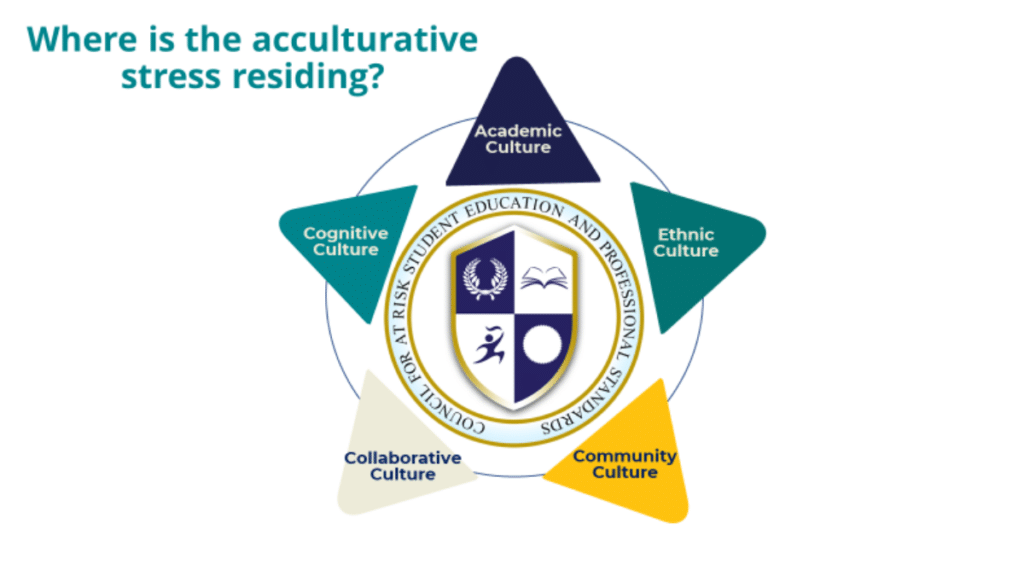
The ACCCE model (Plotts, 2022) provides a systematic way of considering all the aspects of culture that are present in a classroom that make a difference for students:
- Academic culture (00:18) – consider your course planning, announcements, and introductions.
- Cognitive culture (01:08) – consider critical thinking versus divergent thinking.
- Collaborative culture (01:59) – consider how you group students and how you facilitate positive group norms.
- Community culture (03:12) – consider community engagement in the learning environment.
- Ethnic culture (04:10) – consider how best to teach to build on cultural strengths.
Discussions
Which of the five domains within the ACCCE model do you want to explore? How would action in this domain help improve outcomes for your students?
Please share your thoughts and questions in the comments section below.