

Click here to view the video transcript
In this course, I’m underpinning everything with Moore’s Interactional Framework. This framework starts by putting the learner at the top and suggests that what we have is the instructor and the content, and if you think of it like a triangle, each piece is interacting back and forward. Now, when we look at online learning, we have to think about how frequently do we need to interact. In a classroom, you have all that incidental interaction, the looking up, the catching the eye glance with another student, the students looking side to side at each other. When we’re teaching online, we have to plan in those interactions so that every two to five minutes, and that sounds like such a short period of time, we’re stopping and asking the student to interact, interacting with the content, interacting with each other, interacting with you.
Now, we do this by starting with an interaction with us as the instructor, and then encouraging the student to interact student to student. So I can love nothing more than when my students are interacting with me, interacting with each other, and then I can see how they’re interacting with the content. So, whether that’s using an emoji, a poll, a virtual hands up, we’re going to explore each, of planning these interactions in. But we need to start by thinking about where would we naturally look for the interactions with our student if we were giving this as a face-to-face class, or if we were producing a moment where we were talking to a student in the corridor or in our own offices, perhaps after class.
Much of this course is underpinned by one specific concept, Moore’s Interaction Framework, which is especially helpful when considering online courses. Moore (1989) identified three types of interaction inherent in effective online courses: (1) learner-to-learner interaction, (2) learner-to-instructor interaction, and (3) learner-to-content interaction (see Figure 1). Lear et al. (2010) found that interactions with peers, instructors, and content help online learners become active and more engaged in their courses.
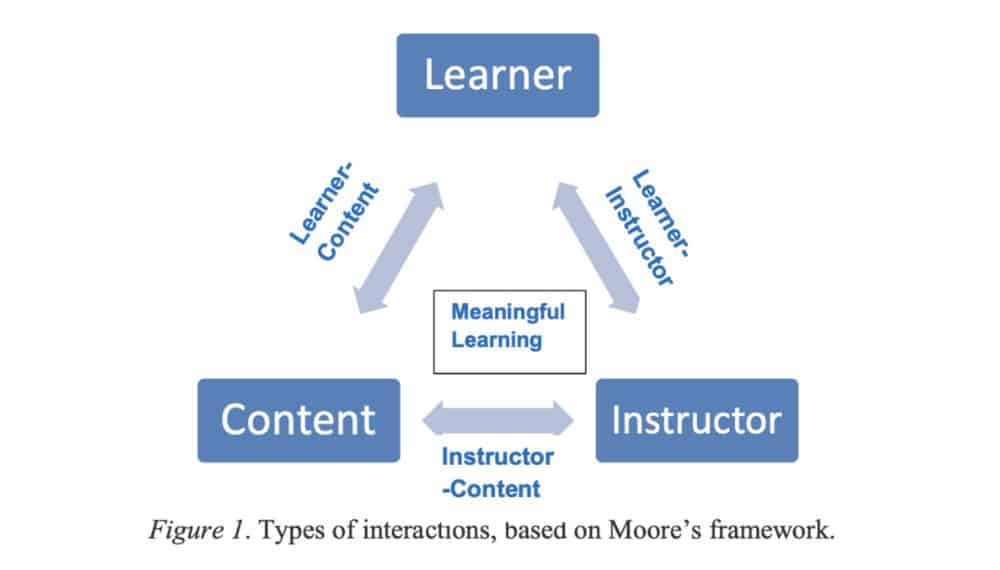
When teaching, it’s helpful to consider how frequently we need to interact. Intentionally plan to create interactional opportunities in your classes. It could be by asking students to post an emoji response to what had been said, a poll to predict what’s coming or check understanding, an activity to interact with the content, a discussion question for breakout rooms. Consider crafting interactional moments every two to five minutes.
If you are using videos in your classes, consider the length of the video you play. The recent research by the University of Illinois Springfield’s Center for Online Learning, Research, and Service suggests that shorter instructional videos under 6 minutes lead to better student engagement and retention compared to longer videos. It is recommended to segment content into brief, focused videos and to provide interactive elements to sustain students’ attention, as students tend to disengage with videos longer than 9-12 minutes.
In the next lesson, we will discuss some more specific strategies you can immediately try in your online classroom.
References:
Center for Online Learning, Research, and Service. (2019). Evidence based video lengths. University of Illinois Springfield COLRS Blog.
Moore, M. J. (1989). Three types of interaction. In K. Harry, M. John, & D. Keegan (Eds.), Distance education theory (pp. 19-24). New York: Routledge.
Discussions
What interactions have you designed into your teaching? When and how often do you aim for engagement, such as every 5 minutes or every 2 minutes in asynchronous settings?
Please share your thoughts and questions in the comments section below.