
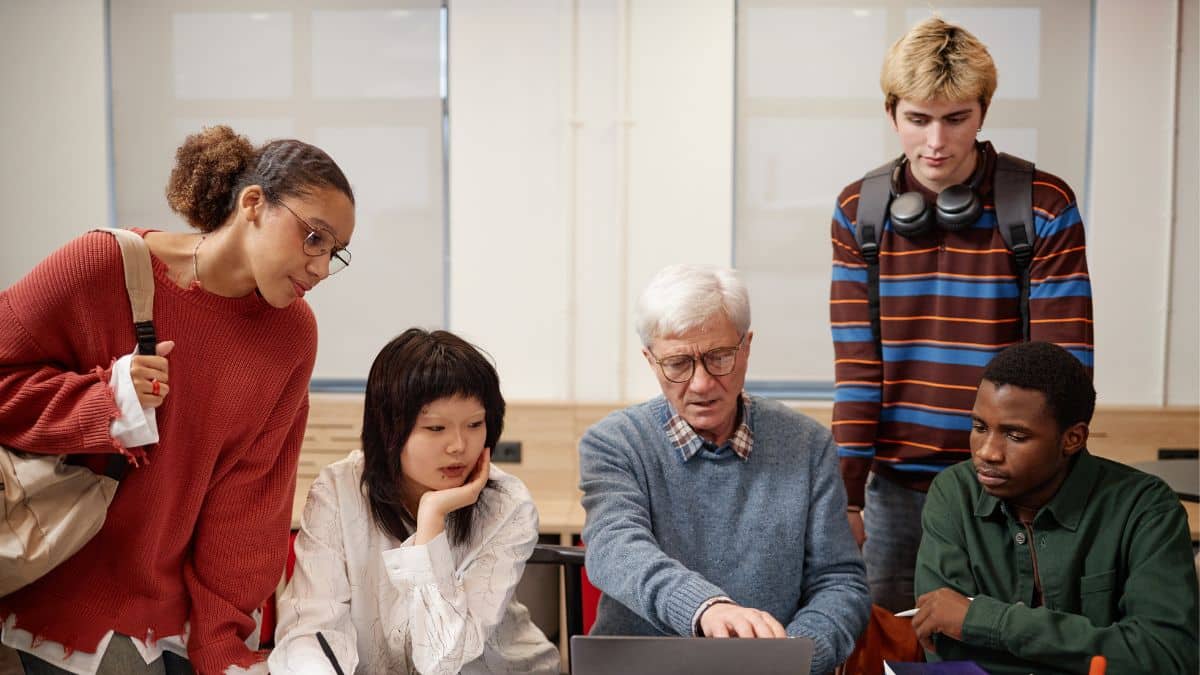
Building Trust with Students in the GenAI Era
Mirjam Glessmer
Rachel Forsyth

Niya Bond
Click here to open or close the video transcript
– Hi, everyone! I’m Niya Bond, the Faculty Developer here at OneHE, and I’m so excited to be joined today by Rachel Forsyth and Mirjam Glessmer. We are going to be talking about a very timely and important topic, and that is trust in student teacher relationships. Welcome to you both for being here. Rachel, I’m hoping we can start with you and could you just give the community a brief introduction and then Miriam the same.
– Hello and thank you very much for inviting us today. My name’s Rachel Forsyth, and I work as an educational developer at Lund University in Sweden. But before that I worked for many years in the UK.
– [Niya] Welcome.
– My name is Mirjam Glessmer. I’m also at Lund University in Sweden, also as an educational developer. I’m originally from Germany. My background was in Germany and Norway and now in Sweden. And yeah, we are very much interested in exploring trusting relationships between teachers and students.
– Well, I’m really glad to be talking with you today. I am big into feminist pedagogy and trust is such a key component of that pedagogy as well as many other inclusive pedagogies. And so, so glad to be having this conversation with you both. If you would, could you share how you got interested in this topic, in this work?
– So a few years ago, I was lucky enough to get accepted onto the Elon University Engaged Learning Research seminar and our group of around 20 people doing research was looking at meaningful relationships in higher education. And our group, which started off as Stacey MacKinnon, Kath Sutherland, Peter Felten and myself decided to look at trust and how it gets built in the classroom. And over the next few years, we interviewed teachers from universities in four different countries and asked them what they did to build trust in their classrooms. It was really interesting. It’s a very under-researched topic and as part of that, I interviewed Mirjam and another colleague of ours, Peter Pearson, who was so interested in it that they suggested we carry on that work. And I’ll let Mirjam explain what happened next.
– Yeah, so in Rachel’s and colleagues works, they were looking at what teachers do to build trust. But then the three of us looked at what do students actually see teachers doing that makes them trust their teachers. So we changed the perspective a little bit because we thought it’s nice and well that teachers do things, but it’s really important to understand if that has any effect on the students, if they notice, if it is working in the way that teachers think it does.
– [Niya] Yeah.
– Yeah, one of the things that came out of that was that we found that students were generally interested in the same kinds of things, but they were very much less interested in teachers’ subject knowledge, which teachers thought was really important. A lot of the students we interviewed said that they trusted that teachers had that knowledge because they were employed at the university and they were more interested, we thought, in teaching skills, which is something that can be taught. So it’s really good news.
– Yeah, that’s really interesting. Now you mentioned the work started with looking at four different countries. Were there any key differences or similarities that you found across these countries?
– We found very little difference in some ways. So the four countries were New Zealand, Canada, the US and Sweden. And we found very little difference in our main, the main areas that we modeled and they were to do with cognition. So knowledge of the subject, knowledge of teaching, affect the way that students felt in the classroom and how teachers tried to influence that. Values. So showing that they have principles and identity, so being sensitive to their own identity and the identity of others in the classroom. And the only one that was really different between the countries was, in Sweden identity was very rarely mentioned either by teachers or by students. And we can speculate as to why that is. We’re not sociologists or political scientists, so probably we won’t do that here, but that was the main area where there were differences, otherwise everything was quite similar.
– Interesting. Now you mentioned the student perspective, which seems like such an important one to incorporate. And you mentioned that they felt more trust when it came to teaching skills, but I imagine even what a learner considers a teaching skill versus what an educator considers a teaching skill could be different. So what were some of those skills?
– So the title of the article that we wrote about it is, students trust teachers who ask, listen and respond. And that is really what it boiled down to. So showing an interest in hearing from the students, then actually listening to what they’re saying and then responding in a way that they feel heard.
– Yeah.
– In a nutshell.
– Yes and I think not not expecting to deal with every single student’s challenges or issues, but just giving off the impression that they cared what happens to the students. They want students to succeed.
– Yeah and students also mentioned that they see the teacher interacting with all their peers. So if the teacher seems to care about a peer, they assume the teacher also cares about them. So they don’t even need the personal experience of-
– Yeah.
– Yeah. necessarily being ‘cared for’ or they don’t need the personal interaction in big classes. They just need to get the general feeling that there is care.
– That there is care and it sounds like human connection, even if they’re witnessing it with an educator and a different learner as long as they can kind of see it in action.
– [Mirjam] Yeah, exactly.
– Now at OneHE, we’re big on practicalities and, so, did anything come from your article or these studies about what educators can do to better ask, listen and respond, say, or engage in care?
– We’ve developed this work now and we’re in the middle of collecting some new data about how trust might be impacted by the availability of generative AI tools.
– Okay.
– Yeah. And this has led to us, I’m gonna say us, but it was Mirjam really putting together a slide. Shall we show it? This is kind of taking the work a tiny bit further based on these discussions about the the AI.
– Yeah, so in addition to the four categories of trust moves that we discussed earlier, we found that there’s also the distinction between teachers saying, trust me to do something and then also I trust you, the student to do something.
– I see.
– So we have a bunch of examples now that are gonna come up, what teachers have said in this context. And we have to say that this is a very preliminary analysis of the data we have. So we only looked at the first five focus groups that we did, we’ve done a lot more since. But these seem to be the patterns still that come up. So what we found is that teachers can do trust moves on the cognition facet saying stuff like, trust me to know the subject and what is important for you to learn right now? And it’s not written there, but trust me to do this more than you trust generative AI. So really trust my expertise, but also trust me to know how to teach and learn in this specific subject and also to explain and model what I think is important about my subject and about your learning.
– Okay.
– And at the same time, I, the teacher trust you, the student to build knowledge, skills and competences yourself and to engage with the course materials and activities. And what we found in our focus group interviews now, where we also have students is, and also another work that we’ve done with students, is that students often go to generative AI because they don’t actually trust their own knowledge and skills and competencies as much as they trust generative AI.
– I see.
– So it is very important for teachers to, say explicitly that you might not trust yourself, but I trust you that you can learn this and can build the knowledge and skills and competencies.
– Yeah. So we talk a lot with generative AI issues about surfacing the process in assessment. But I think also really important that teachers surface their own process here. And when we interviewed teachers, they all thought, trust me was a bit more important. But actually from student perspective, we think that I trust you is also important and many teachers did talk about, I trust you as well and obviously we can share the references to that work, but let’s keep going with this.
– Yeah, so on effect, teachers might say things like, trust me to care about you and your learning and to do my best to create the best conditions for your learning and trust me to react kindly to your mistakes that you might make or that you’re probably gonna make because that’s how learning works. And also trust me to make rules transparent. So I’m not gonna try and trick you into cheating by accident or into doing things that I will then later punish you for.
– Yeah.
– Which I mean, yeah, it seems a little bit funny that you might have to say that, but-
– No, but I think we know from what students have said to us that this does sometimes happen and we don’t mean that you would actually say, I care about you and your learning. It will be showing that in what happens in the classroom and with the materials they get. And saying, I want all my rules to be transparent. If you don’t understand, come and talk to me if things are not going well, but I also expect you, I trust you to take part in things and contribute in the class.
– I love what you said there and how, you know, you can be explicit in your messaging. You can put in syllabi statements or you can speak to trust, but you can also weave it in, as you just said, to the materials into the transparency of the teaching and learning process.
– Yeah, so surfacing that process I think is something that possibly as teachers we’re not used to. I certainly wasn’t something I used to do.
– Yeah.
– Yeah, then we have the values facet, trust me to care about my own professional developments or trust me that I’m trying to stay up to date with technologies that develop extremely quickly and trust me to be open about what I expect and how I check your work. So again, the not tricking you part and also very importantly, trust me to be transparent in how I use generative AI myself. And that might be in the way that I expect students to use it or it might be in different ways, but then at least trust me to have that conversation with you why something is okay for me as a teacher, but not for you as a student. For example, because my assessment is that it’s not helping your learning if you do this specific thing, whereas other things I think might be fine for you.
– Hmm!
– Okay. Then we also have the, I trust you part, either teacher trust you, the student, to actually care about your learning and to commit to what we do together in the course and also to reflect on your learning process and outcomes.
– Yeah.
– Sorry, moving on.
– Yeah, then the last facet that we have is identity. Trust me to be interested in hearing your voice and your thoughts rather than something that comes out of a large language model. And then also I trust you to actually share your own thoughts with me and not pretend something is your thoughts when it’s not. Yeah.
– That’s awesome and you know, I’m thinking about taken for granted processes. You know, I think a lot of people take for granted that both of these sides and everything in between is known, but you know, there are like first generation learners who maybe don’t know these things or other student populations and even educator populations. So, just building that trust and transparency at the same time is so powerful and so meaningful, especially in the era of AI.
– Yeah, these things are true before, but they’ve, so many things have been accelerated or made more obvious by the presence of these products that we now have available. So, we are trying to make some sense of that with this latest round of research but it still comes down to the same things. But I think the good part of what we’ve been working on is that these things are very teachable and learnable by teachers. Even if you don’t always feel like being in the classroom, we all have bad days and so on, you can look as though you do. And that’s really important to students that you turned up and that you cared enough about their learning to join in with things. And we’re not entirely idealistic. We know that this is not always gonna be difficult if you’ve got 300 students learning accountancy who just wanna get a qualification or seemingly just want to get a qualification. You’ve got a different challenge from teaching 10 master students who are hanging onto your every specialist word. But we think that most of these things can be implemented in every classroom. And I think that’s a really helpful message for teachers.
– And it’s also really interesting whenever we’ve shared this overview with teachers, someone has asked, can we have this slide? Because those are things that you might not think to make explicit with your students. And I mean, we don’t suggest that people use the exact words that we have used here, but it seems to be something that people would like to either remind themselves of to show all these different facets, or that they also might wanna use the slide and modify it to their context and then actually make it explicit that I’m interested in building a relationship and those are the different aspects of how I think we should be in trusting each other.
– Yeah, I teach exclusively asynchronously online, and so I’m already thinking about, okay, how can I make what I’m doing more explicit when it comes to what you’ve said about trust and building that connection with learners in that specific environment so I thank you for this.
– That’s awesome and we are only reflecting back to what many teachers have taken the trouble to say to us. So it is really good to hear it could be useful.
– And also when you find great new ways to do it asynchronously online, we would love to hear because we would love to share with more teachers.
– Yeah.
– Of course, we’ll stay in touch. Now you have an article, you have work. Can you tell our community where they can find more about what you’re doing?
– Yes. So the original work with teachers, I had a couple of publications in Teaching and Learning Inquiry, the ISSOTL Journal. And, then, the work we did with students was published in the International Journal of Academic Development. All of those are open access and we can certainly give you the links. The current one, it’s also open access, but it’s just a conference paper, it’s quite short, giving our preliminary results and mapping them to the previous work. So we’d have to send a link. It’s on the Lund University website.
– Yeah, we’ll be happy to share links with the community and continue to follow this very important work. I wanna thank you so much to both of you for your time and I’m excited to see what else you are doing together.
– Thank you.
– Thank you for having us.
– It was exciting. Yeah. Thank you for the invitation.
In their conversation, Niya Bond, OneHE Faculty Developer speaks to Mirjam Glessmer, (Academic Developer, Lund University, Sweeden) and Rachel Forsyth (Senior Educational Developer, Lund University, Sweden) about their research on trust in student-teacher relationships. Mirjam and Rachel share their latest research on building trust in the presence of GenAI. Here are the main three takeaways from their research and conversation:
- Rather than subject knowledge expertise, learners were interested in the ways in which educators showed care for other learners—which is good news, as these are skills that can be taught/enhanced through intentional practice and pedagogy.
- Much of the research is based around building trust through an ask-listen-respond framework.
- Keep two things in mind—that are interconnected:
- Trust me (transparency about educator role/values)
- I trust you (transparency about learner role/values)
If you would like to learn more about Mirjam and Rachel’s research, see their publications:
- Forsyth, R., and Glessmer, M. S. (2025). How teachers build trust with students in the presence of GenAI. LTH:s 13:e Pedagogiska Inspirationskonferens, 4 December 2025.
- Felten, P., Forsyth, R., & Sutherland, K. A. (2023). Building Trust in the Classroom: A Conceptual Model for Teachers, Scholars, and Academic Developers in Higher Education. Teaching & Learning Inquiry, 11.
- Glessmer, M. S., Persson, P., & Forsyth, R. (2025). Engineering students trust teachers who ask, listen, and respond. International Journal for Academic Development, 30(1), 106–119.
- Sutherland, K. A., Forsyth, R., & Felten, P. (2024). Expressions of Trust: How University STEM Teachers Describe the Role of Trust in their Teaching. Teaching and Learning Inquiry, 12, 1–15.
DISCUSSION:
Reflecting on your educational experiences who were the teachers you trusted the most? What made them stand out?
Please share your thoughts in the comments section below.