
Click here to view the video transcript
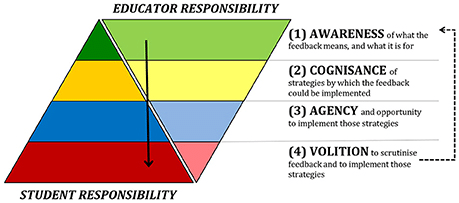
So if we want to overcome some of these barriers that can make it difficult for feedback to have an impact on learning, often the emphasis is placed on educators responding to that challenge, and taking all the responsibility for overcoming the barriers. But we’ve talked about a model of responsibility sharing, where overcoming each of those barriers requires input from both students and staff, and working in partnership to overcome the barriers.
So, for example, that challenge of knowing what feedback means, and being able to understand the language, there’s obviously a really key responsibility on educators to try and frame comments in ways that are clear, and that the students can take action upon, but there’s also an onus on students there to seek further input and guidance, if something isn’t clear, to be willing to ask, so that they can decode the meaning, and therefore use the feedback to improve their learning.
Similarly with those strategies that students may not know how to take action on feedback, I think there’s a really important responsibility on the part of educators to build those skills in students, to take the time within the curriculum to help students understand what kinds of things they can do to take productive action upon the feedback. But there’s still a really important role for students there in asking which of those strategies they should use, perhaps seeking further guidance if the strategy they select isn’t working, so being willing to engage in that dialogue.
And what we argue is that if educators can put in those bits of the process to support students to really understand and use feedback, then overcoming some of the other barriers should then be able to under the control of students. So in terms of feeling in control of using feedback, if as educators we can design assessments so that it’s possible for students to apply feedback from one situation to another, we can enable and empower students to use the feedback, but the students still have a responsibility for looking for those points of transfer, and being willing to apply feedback from one area to another, even if that doesn’t come across particularly easily to them when they look at particular tasks they’re working on.
And finally, in terms of students’ motivation to put in that hard work to use feedback, naturally the main responsibility there is for them, but we can support that as educators by making the use of feedback something that’s valued and rewarded, even built into the assessment pattern itself.
Supporting students’ use of feedback means that you can move towards a model of responsibility – sharing in feedback, where overcoming the barriers described in Lesson 4 becomes a joint endeavour between students and their educators (Nash & Winstone, 2017). For example, overcoming the first barrier described in the previous lesson in a shared-responsibility model means that educators have to provide comments in as clear and constructive a way as possible, and students also have a responsibility to ask and to seek further clarification when the meaning of feedback comments is not clear.
Supporting students’ use of feedback is also an important part of preparing students for life beyond university. In the workplace, it is essential to be able to seek, provide, and receive feedback effectively, so making space within higher education courses to develop these skills is an important part of developing students’ skills in a holistic way.
Within institutions, educators play important roles in realising these opportunities:
- Module tutors play a key role in facilitating use of feedback at the module level, as discussed above. However, there is also an important role for Programme Leaders in designing assessment holistically at the programme level so that the use of feedback is facilitated.
- Personal tutors and academic advisors also have a role to play, in discussing feedback with students and helping them to synthesise feedback from multiple modules and in providing advice on how to develop key skills, as indicated by feedback comments.
- Other important academic-related staff, such as learning developers, also play a central role in supporting students’ use of feedback, in particular, in helping students to ‘decode’ the comments provided by their tutors, as discussed in Gravett & Winstone (2019).
References:
Gravett, K. & Winstone, N. E. (2019). 'Feedback interpreters': the role of learning development professionals in facilitating university students' engagement with feedback. Teaching in Higher Education, 24(6), 723-738, DOI:
Nash, R. A. & Winstone, N. E. (2017). Responsibility-Sharing in the Giving and Receiving of Assessment Feedback. Frontiers in psychology.
Discussions
What good examples of supporting students' use of feedback have you seen?
Please share your thoughts and questions in the comments section below.