

Dealing with AI: A Card-Based Approach to Human-Centered Learning

Carter Moulton
Click here to open or close the video transcript
– Great, all right, so yes, my name is Carter Moulton. My pronouns are he/him. I am a faculty developer at Colorado School of Mines. I work in the Center for Teaching and Learning there, and I am also the creator of this Analog Inspiration AI card deck. I hope you can see that I like to have fun with the wording and the titling of everything. We are, many of us, dealing with AI, whether it’s in the classroom or at our centers for teaching and learning. Maybe some of us. When I wrote this, I was a little sick of talking about AI, right? Just think we’re on these different mindsets about how we are experiencing AI in this moment. So I wanted to just share a little bit about the project with you all and really give everyone a chance to do some reflection on values and skills that are driving our work in this moment.
And so to get started, I was hoping we could just take a minute, you’ve already introduced yourselves maybe, but drop one value into the chat, something that drives your teaching practice, or maybe if you work at a center in educational development, what’s a value that really drives your work? I’d love to see some of those roll in. Wow, transparency, trust, connection, kindness. Oh, see, this is the fun part of this project, is there’s so many values we have. There is no card that I’ve created called kindness, and I’m like, “That should be a card.” Human value we have, belonging, great. And so, yeah, we can already enter that mindset of thinking about values, and I think values can be a way forward in this moment when we don’t know what to do. In fact, a lot of the times, when we look at difficult scenarios we might face in the classroom, focusing on those values can help guide our actions in those moments. I’ll talk a bit more about that. S
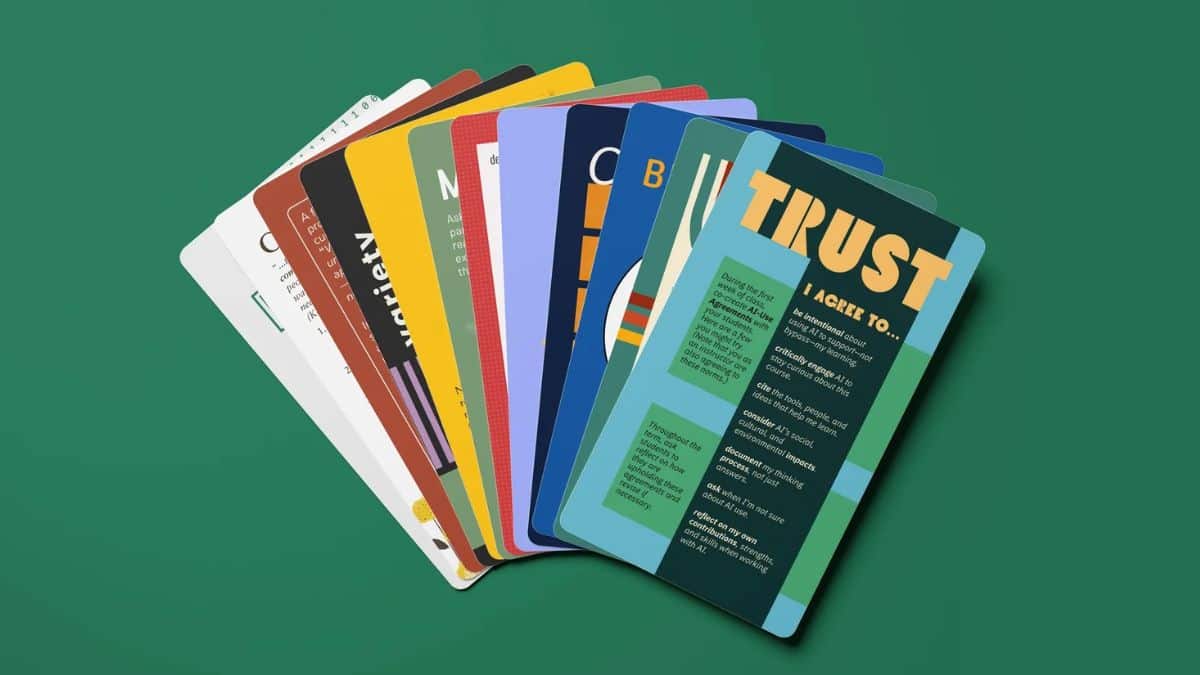
o I hope to kind of share my approach to educational development in the age of AI through this card deck project. For me, I think no matter how you feel about generative AI, its emergence does offer us an opportunity to revisit why we teach, what we teach, how we teach, and how we can center learning and build environments of curiosity and care for our students. So, I always like to begin with sort of a reflection on the words that we use when we talk about AI. My background is in the humanities, cultural studies, media studies, so I’m always interested in the discourses and how they shape our approaches to technology. So, we see these terms, terms like efficiency, acceleration, we can make our lives easier, we can offload some of our responsibilities that we don’t care about to free up time for what matters, and then, scaling and personalizing, these are sort of the words that we use to talk about this technology. And so, my project just begins with the idea of what if we changed the words that we’re emphasizing right now? What are these values of efficiency and automation? Who are they for and why do we need them? And so, re-centering human values and skills and concerns, I think, is a big project that this card deck tries to undertake. So, these are words that, of course, matter to me and guide my own teaching practice, but I think there are a lot of us who would agree that these sorts of values are reflected in our work. And so, yes, I created a card deck, and it’s called Analog Inspiration and, there’s 48 cards in this pack. And then, I created an expansion, and so there’s now up to 80-ish cards or so, and each card has a different value, skill, or concern on it, and one practical way or thought exercise or some sort of accompanying text, sometimes they have a quote, to really think about and reflect on that value or that concern we’re having. And then, try to give practical strategies for educators in the classroom. So, I made it as a card deck to try to build that connection among faculty, among educators and teachers in their context.
And so, Trust. Trust is, of course, one that many of you said in that first reflection, and so the trust card, for instance, offers some sample agreements that you might bring students into the conversation to set appropriate AI use guidelines or community agreements that you all uphold, including the instructor. So these would be community agreements that you all agree to, such as, “I agree to be intentional about when using AI to support, not bypass my learning,” or, “I agree to be proactive when I have a question about using AI.” “I agree to cite the tools and people that help me learn.” So that would be, again, a responsibility of the instructor as well. So overall, I view this project as trying to promote a human-centered AI pedagogy that focuses less on the capabilities of the tools and more about what are we doing with these tools? How are we centering the whole human-student and their learning? So, what I’ve found by the response of this card deck project, which has been surprising to me, is just how, I don’t know, rich some of the conversations have been among faculty to use these card decks together in their community to discuss their values, whether you’re skeptical about AI or you’re really excited about AI, leaning in with values-driven conversations. Sometimes students are brought in to that conversation as well.
And then, there’s also that practical strategy piece. Some of the cards integrate AI, some of them ask us to resist AI, and some of them ask us to interrogate AI to center those values. And then, of course, another part of the project is trying to counteract what we’re seeing with this idea of urgency and speed and efficiency to make time for spaces where faculty can get together, reflect, discuss, not have to create anything for their course necessarily, but just kind of reflect and be intentional about their uses of AI in the classroom. So I wanna provide this as a frame, and I think this is kind of how the card deck functions and it approaches AI. It approaches AI as something that is threatening multiple aspects of what we mean by human-centered learning, and we can start with our brains. I think we’re getting a lot of research in this area about how AI is being used as a cognitive crutch, cognitive surrender, or this idea that even entering with good intentions, trying to be human first, we often lose sight of that when we iterate with AI and we start to get these sort of options about how to move forward, we lose some of that critical discernment. And then another term, metacognitive laziness. There’s all sorts of terms going around in the research, but it also is affecting students’ nervous systems, right?
I always like to share the story of the student who, for a creative writing essay, had an original creative writing essay that they were happy with, but they were so nervous that the instructor was going to run it through an AI detection tool that they proactively did so of their own writing, and the detection tool said 23% AI generated. And so, what they then did was go line by line and edit their own writing until that number hits zero. And so, we can see how this culture of fear, this culture of being caught or called out is really affecting student learning in a negative way, especially when we’re trying to teach creative thinking and voice and argument. And of course, our students are navigating five different AI policies. We may have one instructor saying, “This is the future and you need this.” And we have another instructor saying, “This is academic misconduct.” And they’re also very nervous about the world in general, as we all are, and their future careers and how those are changing. So, we need to tend to that as well, and we also need to tend to our hearts. I think this is something we don’t necessarily talk about enough, but the social isolation, the emotional dependence. If I’m going to seek support from AI rather than my instructor or my community of learners, or the campus units, the career center, or the counseling center, how can we address that? So, the card decks offer a variety of different ideas.
So, some of them focus more on how faculty might redesign their assignments to preserve some of that critical thinking. Some of the cards really focus on trust and transparency and communication. We’ll get into that in a second. And then some of them really focus on, and my passion is making sure we center human relationships and connections in this moment for our students. So, what I wanted to do, this is sort of the interactive component of this moment here, is if we go to this website, analoginspiration.ai/reflection, I’ve created what I’m calling a digital card table, and this is, essentially, if you collect cards or you’re into card collecting culture, you may be familiar with the idea of a starter pack, sort of a themed group of cards. You can’t really open these ones, but they’re there for you. I’ve themed some of the cards, and this is for you to explore. If you wanted to just take two to three minutes of quiet reflection to kind of peruse that website, look over some of the cards and ask yourself the question, “How does this concept show up in my teaching?” For instance, one of the cards is excitement. How does excitement show up in your teaching? Or maybe it doesn’t. Maybe it’s something you wanna move toward a little bit more in your future. So, try to look over some of the cards and connect with one and do that quiet reflection. We’ll do two minutes of this and then we’ll come back. Feel free to share your insights in the chat as we do this, and we’ll come back in two minutes.
I’ll start it now. Okay, well, that’s just a little exercise. I mean, that website is there for you to kind of explore, and for those watching the recording, feel free to explore that as a way to just kind of get a sense of what some of the cards are about. And I’ve kind of grouped them into different starter packs. Some of the cards are about redesigning your assessments, as was mentioned, to really help students develop that growth mindset. So, where could we use AI in terms of learning from your mistakes and then explaining what you learned, right? And, if we’re putting learning at the center, is that something we can afford in our class, to open up more space somewhere to learn from your mistakes? Or, the rest card is just a reminder that our students are producing, we’re producing at these crazy levels, especially now with AI here. When are they told it’s okay to rest? And how can we do that? When are we feeling like we’re able to rest? Some of those reflections. So, I think when faculty discuss those items, those different concepts, they get a lot out of it.
So, I’m just gonna go through – we don’t have much time, some of the themes of the cards – and here we’re, looking at the responsibility card, which is a double-sided card, has questions for students, and it has questions for teachers, right? And transparency, this can really help build a culture of mutual responsibility and trust. And also, I like to use scenarios, right? So providing faculty with a scenario, a real scenario of your department head has reached out to you and told you that a student has reported you because they feel like you’re using AI to offload your responsibility as an instructor, right? How do you approach that scenario using these values, maybe either to proactively be transparent about how you will or won’t use AI as an instructor, or, in that moment, when you need to meet with the student and talk with them, a card like curiosity might help you enter into that conversation. Some of the cards are actually inviting you to interrogate AI itself in terms of students taking a critical lens toward this technology if they wanna explore the biases baked into these datasets, or they want to visualize what it might look like to validate an AI output. So I call this “truth trails”, where they use AI for maybe a project-based assignment, but then they trace that output by verifying what sources were talked about, looking at page numbers, looking at information that was missed or incomplete, and kind of visualizing that as a way to tell the truth about an AI output. So that’s sort of using the AI output as text to interrogate some of the ethical concerns, and sustainability, of course, about the environment. And then some of them are about this redesigning assignments to preserve productive friction.
I’m gonna kind of just showcase here that some of these are about when not to use AI and how you might redesign your assessments to make thinking visible. So students actually explaining or justifying their decisions, explaining their work to you. The thing I like to emphasize about an oral assessment is that it also an opportunity to interact. It’s an interaction, it’s a relationship building moment for students. It can be, right? It comes with a lot of anxiety. We need to make sure our students have options and they have a chance to practice in an ungraded setting, but viewing that just as a way to get to know our students, I think, is a great thing. And then some of the cards also say you might use AI to build in more friction. If you are working on a thesis or a project pitch, a prototype, ask AI for different audiences. What would a skeptical audience say of this work? Or, what is a critical lens that I’m not thinking about right now? We can take students’ work, where maybe they’re feeling good about it and they’re feeling like this is a thesis I’m going to pursue and really interrogate that work a little bit more to get different opinions. And of course, integrating that with maybe a peer review, right? We don’t wanna stop and just not have that communication between students too. One thing I really like to emphasize is there may be an opportunity for interruption to be an interesting pedagogical technique here.
So this idea of cognitive surrender is this idea that we’re not just saying, “I’m going to offload this to AI,” it’s that we are unknowingly kind of surrendering over time the options. We’re maybe moving away from human-first cognition towards just sort of accepting what AI outputs give us, and so I’ve done activities with students where we ask them to use AI collaboratively in the classroom and to keep a human-first mindset, but about five or six minutes in, you’ll notice people stop talking to one another and they’re really starting to look at their screens. They’re really starting to say, “Oh, AI said we should do this,” and so I like to interrupt and just say, “Okay, let’s do a gut check. Who is driving this idea right now? Is it you or the AI” to actually kind of like break out of that process of using AI and reflecting on it in the moment Just a thought, and I think the in-class portion of AI use is sort of something we can play creatively with to get our students to think critically. One I also like to put in there is efficiency. I ask is efficiency a human value? There’s a quote from John Warner that says, “Learning is not better when it happens more quickly.” So who is valuing efficiency? And you know, if you’re in a group project, maybe you’ve experienced this, where you’ve gotten something from a group member that is AI generated and it actually makes more work for you because it lacks context and you’d actually rather just start from scratch. So we could play with that and have our students actually feel this frustration of somebody offloading their responsibility and reflecting on that as well in collaborative contexts.
And I’ll end here just by saying that a lot of the cards really do focus on community, care, relationships, creating a space that is socially rich for students and it feels exciting, and I think that’s kind of my passion and it’s something I’m really worried about with AI in terms of scaling and having AI tutors and so forth, is where is that human connection, why should a student come to office hours when they can just ask AI, why should a student raise their hand and ask a question and engage if they’re feeling nervous in the first place? So a lot of these cards do provide ideas. I like the excitement card. Ask students to really generate promotional material for their project, get the classmates excited about that project, and kind of take creative ownership over their project, and they can use AI to create some fun promotional material, as an example. So with that, I’ll stop. I just want to end on the card here that’s in the expansion pact. It’s sort of the humility grace card, but as we do all of these experiments and we keep trying to learn about what the research says, and then the research is retracted because of methodological errors and we’re just exhausted, right? I would just say give yourself some grace to try one thing that feels aligned with those values, feels aligned with how you know your students learn from it. We are all figuring it out in real time, and, maybe, a first step is simply getting together with other faculty in your community, sharing how it’s going, sharing what your values are, and trying to support student learning. So I wanna say thank you. We’ll stop there. I’m happy to answer any questions folks have, and I just wanna say thanks.
– Thank you, Carter. That was very beautiful and I really appreciate your human-centered approach of thinking of learners as holistically. It’s the brains, nervous system, and hearts, I think that also applies to faculty, so it was a beautiful note to end the talk. We have a question in the Q&A, and I will just encourage people to post, we’ve got some more time with Carter, we can ask him questions, so please feel free to submit them in the Q&A section. So the question from Heather is, “I believe I saw a tool you created and question whether it was called Glass Box, and I thought that was useful and wondered how we could use that with students,” so…
– Great. Yeah, I will talk about that. Thanks for whoever saw that. That’s great. Let me actually just share my screen again. I’ll share this with you. So I think what I’m working on now is we’ve got the Analog Inspiration cards that folks are using. I’m trying to think very carefully about are there opportunities where we can build in digital, I’m calling it digital experimentation, so you can go to this website here, and tools that we can help our students develop AI literacy, and so this is the Glass box AI that I developed. It’s really just a Google Gemini Gem, which is a custom chat bot. Anyone can make one of these, but this is an idea that, I think, can help our students understand how AI works, and it really resists this idea that AI is a magical black box, right? The idea that we ask it a question, it gives us an answer, it feels like a human on the other end, right? It’s very confident, it’s very sycophantic in telling us what we want to hear. This tool actually is a custom chat bot where you can invite students to go in there and ask it any question, so Glass Box AI, generative AI is designed to operate as a magical black box, this tool aims to prioritize transparency and demystify. So I asked it Cattle Dog Nipping for instance, and then I asked it,”Who is Carter Moulton?” Right? So I’m playing around with, but let’s look at, “What are the top 5 songs of the 1990s?” Right? So, what it’s gonna do is – it’s gonna give you its answer. I love a live demo also because it probably will fail, but, so, it gives you an answer, right? This is what you might see if a student were to enter this, but then there’s a second part here, that’s so good, I love it, where it didn’t work. That’s why I call it experiment. It’s not perfect. Let’s try again, let’s go to my bio here. So what it should do, and play around with it please, but it gives you an answer, right? So who is Carter Moulton? It gives you this answer here, and then it gives you an insight into how it generated that answer. Okay, so when you submitted the query who is Carter Moulton, I broke it apart in this way, right? So you can get into the actual technical piece of how it generated, so for instance, I have a high statistical certainty regarding Dr. Moulton’s current institutional affiliation, his degree, ’cause those are on my website. My certainty drops when synthesizing descriptions in his philosophy because concepts like care and pedagogy are abstract and appear across billions of… And then it also provides where I may be wrong, it reflects a Western-centric, internet-dominant data bias. And then also a conversation with Dr. Moulton himself may provide a much more complete and accurate picture. My data’s frozen and generalized. So it’s really playing into this idea of getting an answer, but then how is it breaking open my prompt into tokens? How is it rearranging and how is statistical probabilistic thinking working to generate an answer to help our students understand it’s a probabilistic text generation tool. So play around with it, give me some feedback. I just released this like last week, or I didn’t release it, I just posted it, so still playing around with it. But I think that’s the kind of thing we can do to try to get an interactive sense, an experiential sense of AI literacy for students.
– Oh, thanks for sharing. So we have another question in the Q&A. Can you see the Q&A? It’s quite a long question.
– Oh yeah.
– Quickly, I’ll let you read it, but for the purposes of the recording, the question is asking whether you’ve had any instructors share student feedback from using the cards and where to get started with it.
– If I could have just a second to finish reading this. Example of student feedback, the overwhelmingness, where to begin, so knowing what has worked with students may be useful. As such, which of these strategies do students resonate with most, and recognizing that students in different stages of their learning can respond differently? Yeah, so the feedback piece, I don’t have much feedback in terms of an instructor saying, “Hey, I’ve tried this card idea specifically.” Now, I know, for instance, many faculty I work with have done – for instance – the growth mindset card talks about exam corrections – and so I do have evidence from many faculty who speak with their students about this chance to try again really does support their learning. And of course, try to create all these cards, many of the cards have the literature behind it and a quote along the card to kind of show the evidence-based nature of these strategies. But it does make me think of an interesting story I’ve experienced. I’ve led workshops where I have students and faculty use the cards together and, I ask the students, share a time where maybe one of these values was missing from the course. Maybe you took a course where you didn’t have that trust, you didn’t have that care. How did it feel? How did it impact your learning? And I really loved – basically – this was a context where the faculty didn’t know that I created the cards, so they were kind of reacting in real time. One faculty member was holding the joy card and the care card, and I heard them say, “Oh, these cards are no good. I don’t like these.” And I was like, “Interesting.” Okay, so it seems like maybe you need that card, but they were sitting with a student, and so after they passed around some of the cards, the student shared the joy card and they talked about a course where they had just no sense of joy in the classroom and how they just really checked out, and they showed up well the first few weeks, but then over the course of the term, they just kind of fell apart because they didn’t feel that spark there. And watching that faculty member listen to the student was one of the most rewarding things, just kind of how their demeanor changed of realizing that joy really does matter to students, it really does impact learning. So, yeah, I don’t have great feedback of a faculty member saying, “I tried this particular card,” but if you’re interested, please do let me know. Always wanting to hear.
How can educators integrate, interrogate, and respond to AI without losing what matters most in the classroom? Shuffling through the Analog Inspiration card deck, Carter Moulton explores innovative approaches to AI integration that promote values-driven teaching, increase intrinsic motivation, and preserve productive friction. The cards created by Carter highlight concepts such as “joy,” “friction,” “sustainability,” “responsibility,” “celebration,” and “problem identification,” helping educators reflect on the human values, skills, and concerns that can anchor pedagogical work in a time of exhausting uncertainty.
Useful resources
- Analog Inspiration – A card deck to inspire human-centered teaching and learning in the age of generative artificial intelligence.
- Analog Inspiration Google Sheet – This free spreadsheet contains 47 teaching ideas from the Analog Inspiration card deck.
Suggested OneHE content
- Promoting Human-Centered Pedagogy in the Age of AI – interview (free)
- Exploring the Ethics of GenAI with Students – webinar recording (free)
- Getting Creative (and Critical) with AI Literacy – interview (free)
- AI Boundaries: Setting the Rules of Engagement for Your Classroom – webinar recording (sign in to view, or start a free 10-day trial).
DISCUSSION:
What is your main take away after watching this webinar recording?
Please share your thoughts in the comments section below.