

‘The Spark of Learning’: An Interview with Sarah Rose Cavanagh

James M. Lang

Sarah Rose Cavanagh

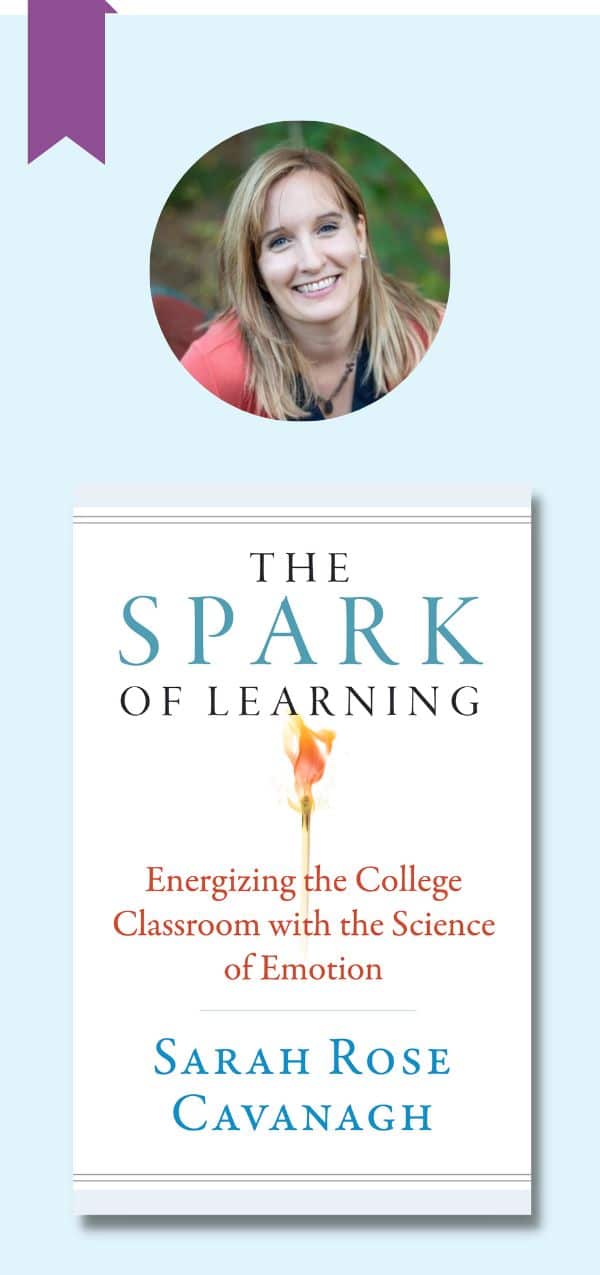
The book that launched the West Virigina University Press book series on Teaching and Learning in Higher Ed was The Spark of Learning: Energizing the College Classroom with the Science of Emotion by Sarah Rose Cavanagh, who currently serves as the Senior Associate Director for Teaching and Learning at Simmons University. Published in 2016, Spark remains one of the most consistent sellers in the series. Cavanagh, an affective scientist, brings her research on emotions to the teaching and learning process. We tend to talk about learning in cognitive terms, focusing on intellectual skills like thinking, interpreting, and problem-solving. But as Cavanagh argues, emotions condition everything we do, including our learning. The Spark of Learning shows teachers how a better understanding of student (and teacher) emotions can support better learning in higher education.
James M. Lang, Ph.D.

Click here to open or close the video transcript
– We are here with Sarah Cavanagh, the author of The Spark of Learning. And here are five questions for Sarah. So when you first began working on this book, which was published in 2016, the discourse, the discourse on emotions and the teaching and learning process was much lighter than it is now. So what do you think has changed?
– Well, I think like most things in life, it’s a whole bunch of different things at once. I think increasingly universities started investing in teaching and learning centers and in pedagogical training and there were just naturally increased conversations among faculty and educational developers about how best to engage students. And I think that emotions are a natural way to engage students. And so there was a lot of that. I think the pandemic certainly amplified attention to things like trauma, stress, the role of community in learning. So I think that was a big factor, but I think it was also part of a broader movement concentrated in psychology, but also across other disciplines. There was a year or two ago, a whole ton of psychologists, very famous people, got together and co-published an article in Nature Human Behaviour called The Rise of Affectism, where affect is just a fancy word for emotion. And they argued that we’ve had behaviorism, we had the cognitive revolution, we had neuroscience, and now affect is going to be king for a while. And so I think that there was a lot of attention to emotion more broadly speaking.
– So what were you hoping the teachers would take away from the research you presented in the book on how emotions impact learning?
– I think the most important thing that I would like people to take from the book is that we are not purely rational creatures. That as much as we like to leave emotions at the door of the classroom or our intellectual work, that learning and thinking are themselves deeply emotional. That student motivation is key. If students aren’t motivated to learn, they’re not going to learn. And so attending to the emotional climate of our classrooms can really deepen student learning.
– So let’s talk about the process of writing a book. This was your first book and the prospect of writing a book can be intimidating to many academics. So what did you learn about writing books along the way?
– Well first get yourself a writer’s group. I think that having a team of people writing together can be really important for accountability reasons, for getting great feedback on your writing, and having a small audience to test everything out on. And then just also for fun, for the enjoyment of it. And I think the other thing that I learned is that it’s important not to be so strict about holding to your first ideas and being willing to shift things around. If your writer’s group want you to reorganize your book on a whiteboard for instance, go with that. And I think that Scrivener is a great kind of practical suggestion. It’s a software program that allows you to really do that, to have like chunks of writing and then just be able to move things fluidly around. I think the other thing I would say is that it’s important to have a strong idea that you’re really passionate about, which sounds pretty obvious, but I think my second book I had a lot of fun and I’m glad that I wrote it, but was sort of just a tour through some of the most interesting research that I had been talking with my students about in social neuroscience. And I think that it would’ve been a better book if it had a stronger through line. And, and my most recent book which is due out in May and which you can pre-order now, is called Mind Over Monsters, Supporting Youth Mental Health with Compassionate Challenge. And that is a pretty strong idea and it’s a topic that I’m very passionate about and is close to my heart. And it was easier to write, I think, and easier to talk about on podcasts and things like that because it has more of a strong central argument.
– So maybe following up a little on that last question, so you’ve obviously written two books since Spark was published. Has the writing process got easier? It sounds like you’ve found a way to motivate yourself as a writer, but what about the actual process? Did it get any easier?
– Yes. I think knowing what to expect and knowing the path and what is going to happen at each point and knowing just some of the mechanics of copy edits and page proofs and things like that, all made things a lot easier. And then with the publicity aspect, knowing what to expect there and, but I think the act of writing is always just, you know, finding time to sit down and write and that hasn’t changed terribly much.
– Yeah, yeah, definitely, that’s a challenge. So if readers would like to learn more about the Spark of Learning or your more, your recent books, and the one that’s coming out in, did you say March, March of 2023?
– May.
– May 2023, we’ll look forward to that. And where readers could learn more about your work generally or where should they, where should they look? Do you have a website, do you have social media? Are you available for lectures or workshops on other campuses?
– Yes. So I think about a month ago I would’ve said find me on twitter.com, but things are not going so hot over there. So I guess my website, which is Sarah with an H, Rose Cav, C-A-V, dot com, SarahRoseCav.com, is probably the best place to find me. And I do do workshops and lectures on other campuses. I have a full-time role that keeps me pretty busy at Simmons University. So if you’re gonna ask, ask early, but I do do that work and I really enjoy talking with faculty on all sorts of different campuses.
– Alright, excellent, thank you. And we’ll look forward to your new book. Thank you.
– Thanks again.
Excerpt from the book
PREFACE
In graduate school, professor Holly Taylor of Tufts University gave me and my fellow classmates this advice on how to present an audience with new information (channeling Aristotle, if Google can be trusted): “Tell them what you’re going to tell them, then tell them, then tell them what you’ve told them.”
I found this so convincing that I am going to tell you what I’m going to tell you twice.
Here is the short version: I am going to argue that if you want to grab the attention of your students, mobilize their efforts, prolong their persistence, permanently change how they see the world, and maximize the chances that they will retain the material you’re teaching them over the long term, then there is no better approach than to target their emotions. I will advise that you consider the emotions of your students when managing how you present yourself to the class, when designing your syllabus and assignments, when considering which activities to include in a given class session and how to frame those activities, and when grading and providing feedback to your students.
As a teaser of sorts, below are some of the proposed techniques you will find scattered throughout the chapters to come.
I will suggest that you:
- intentionally confuse your students
- kick back and watch some popular movie trailers together
- engage in a little role-playing
- teach your students how to breathe
- tell stories about your own failures as a student
- flip how you grade
- let go of guilt and instead put sleep, exercise, and leisure at the forefront of your priorities
- spend some good time on YouTube watching silly videos with your students
- completely change how you ask questions of your students
- decide once and for all to ban technology in the classroom—or else, allow liberal use of it
Some of these suggestions have been tested in applied, rigorously controlled experimental designs, and others are supported by more basic research being conducted in laboratories and classrooms on emotion science, neuroscience, and education around the world. I’ll share this evidence with you as we go, and each chapter will also have a list of suggestions for further reading if you find your appetite whetted.
So without further ado, let me . . . um, tell you what I’m going to tell you some more.
For discussion
Cavanagh makes the case for cultivating certain emotions in the classroom, such as curiosity and wonder. Where do you see student emotions playing a positive role in your courses?